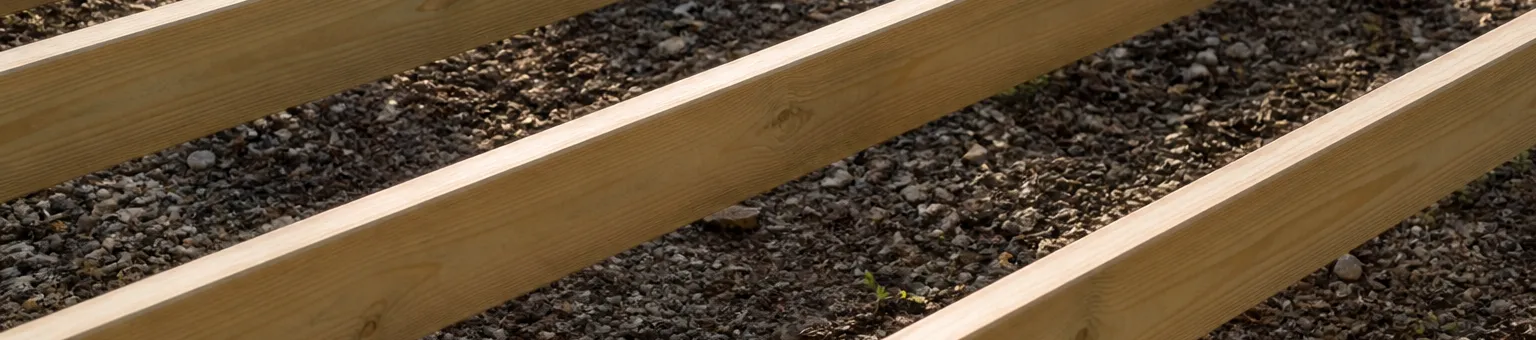
Deflection is the word engineers use for the tiny amount a board bends when weight is applied. Every material flexes a little, but a deck with too much deflection has a bounce that is hard to ignore once you have felt it. The good news is that deflection is almost entirely determined during the framing stage, before a single surface board goes down.
The physics of the solid floor
When we talk about deck stability, we are primarily dealing with deflection. Every material has some natural flex, but too much of it creates a springy feeling that makes even the most expensive deck feel flimsy.
The relationship between joist spacing and deflection is not linear. Reducing the gap between the joists does not just make the frame stronger, it significantly increases the stiffness of the surface boards above it. When the skeleton of the deck is rigid, the energy of your footsteps is absorbed and distributed quickly, creating that sought after feeling of standing on solid ground.
Understanding on-center measurements
In deck building, spacing is almost always measured on center. This is a useful distinction during the planning phase. Instead of measuring the air gap between the joists, you measure from the center of one joist to the center of the next.
This method aligns with how building materials are made. Since a standard joist is 1.5 inches (38 mm) thick, an on-center measurement ensures that when two deck boards meet end to end, they both have a 0.75 inch (19 mm) shelf of wood to sit on. Most residential decks settle on a standard of 16 inches (406 mm) on center. This increment is popular because it divides evenly into standard 8 foot (2438 mm), 12 foot (3658 mm), and 16 foot (4877 mm) lumber lengths, minimizing waste while providing plenty of support for standard 5/4 inch (32 mm) or 2 inch (51 mm) thick deck boards.
Why wood species dictates your frame
Not all wood is created equal when it comes to structural integrity. The stiffness of timber is measured by its Modulus of Elasticity, and this number varies considerably between species.
Standard pressure treated softwood, such as Southern Yellow Pine or Cedar, is a staple in backyard construction. It is affordable and easy to work with, but it is also relatively flexible. Because these woods can expand and contract significantly with changing humidity, a tighter joist spacing acts as a stabilizer. It holds the boards flat and keeps them from cupping or twisting as they age in the sun.
If you move into the world of tropical hardwoods like Ipe or Cumaru, the rules change. These woods are incredibly dense, some are so heavy they actually sink in water. While they are naturally much stiffer than pine, they are also prone to significant movement if they are not pinned down properly. Even though these boards could technically span a wider gap without breaking, most builders still stick to 16 inch (406 mm) or even 12 inch (305 mm) spacing to keep these expensive planks perfectly aligned for the next thirty years.
The challenge of composite decking
Composite decking has changed the industry with its low maintenance and uniform look, but it behaves very differently than natural timber. Composite boards are made from a mix of wood fibers and plastic, which makes them more flexible than pure wood.
If you place composite boards on a frame designed for the absolute maximum span of natural timber, you might notice a spongy feel, especially on hot summer days when the plastic components in the boards soften. This is why most composite manufacturers have strict requirements for joist spacing, often capping it at 16 inches (406 mm) for straight layouts and 12 inches (305 mm) for diagonal patterns. Ignoring these specifications does not just result in a bouncy deck, it can lead to permanent sagging and will almost certainly void your warranty.
Designing for patterns and zones
One of the most common reasons for adjusting joist spacing is the aesthetic design of the deck surface. If you want to elevate the look of your project with a diagonal board pattern, you have to adjust the skeleton below.
When boards are laid at a 45 degree angle, the actual distance a board travels between joists increases by about 40 percent. To keep the same level of support as a straight laid deck at 16 inches (406 mm) on center, tighten the joists to 12 inches (305 mm) on center.
The same logic applies to picture frame borders or transition boards. These decorative elements often require ladder blocking, which is short pieces of joist material installed perpendicular to the main frame, to provide a continuous nailing surface. Planning these zones before you buy your lumber keeps the stability of the deck consistent even where the design becomes complex.
Planning for live versus dead loads
A deck is a dynamic structure. In engineering terms, we talk about dead loads, which is the weight of the deck itself, and live loads, which includes people, furniture, and snow.
A standard residential deck is typically designed to handle a total load of about 50 pounds per square foot (244 kg per square meter). This is more than enough for a grill and some patio chairs. Modern outdoor living, however, often involves much heavier features. A large masonry outdoor kitchen, a stone fireplace, or a group of oversized planters can easily exceed these standard limits.
The most extreme example is a hot tub. A medium sized hot tub filled with water and people can weigh upwards of 4,000 pounds (1814 kg). This weight is not distributed across the whole deck, it is concentrated in one small area. Supporting this requires a fundamental shift in the frame, often involving joists spaced at 8 inches (203 mm) or 10 inches (254 mm) on center, doubled up beams, and extra support posts directly under the load. Identifying these heavy zones during the planning phase is the difference between a successful project and a structural failure.
The hidden role of airflow
Stability is not just about how the deck feels today, it is about how long it stays that way. One of the most overlooked benefits of proper joist spacing and framing is airflow.
Wood rot is the primary enemy of deck stability. When joists are spaced correctly and the boards above have the proper gaps, air can circulate through the structure. This lets the timber dry out after a rainstorm. If the framing is too cramped or poorly planned, moisture can get trapped between the deck boards and the tops of the joists, leading to joist rot. Many modern builders now use joist tape, a waterproof membrane applied to the top of the joist, to add another layer of protection.
Security for the seasons ahead
Investing in a solid frame is a hedge against the future. As a deck ages and the wood goes through hundreds of wet and dry cycles, the internal stresses in the timber want to pull the structure apart. A frame with tighter joist spacing has more fasteners per board, which means more points of contact to keep the wood in check.
A common mistake is trying to save a few hundred dollars by spacing joists at the absolute maximum allowed by code. The cost of the extra lumber is usually a small fraction of the total project budget. Since it is almost impossible to fix a bouncy deck once the surface is installed, over engineering the frame slightly is almost always the smarter financial move.
General guidelines provide a good starting point for your design, but every home is unique. Local building codes, soil conditions, and regional weather patterns will always shape the final requirements. Taking your plan to your local building department is the final piece of the puzzle, ensuring your new outdoor space is as safe as it is beautiful.